
Be the Super Generation that saves the monarchs
Join the Illinois Monarch Project statewide initiative as we conserve the breeding and feeding habitat of the monarch butterfly and other regional pollinators.
Thanks to your involvement, we’re celebrating major monarch milestones as part of our 10-year progress report. But the work isn’t done yet. Read on to learn more about what we’ve accomplished and what’s in store for 2038.

Monarchs in Illinois
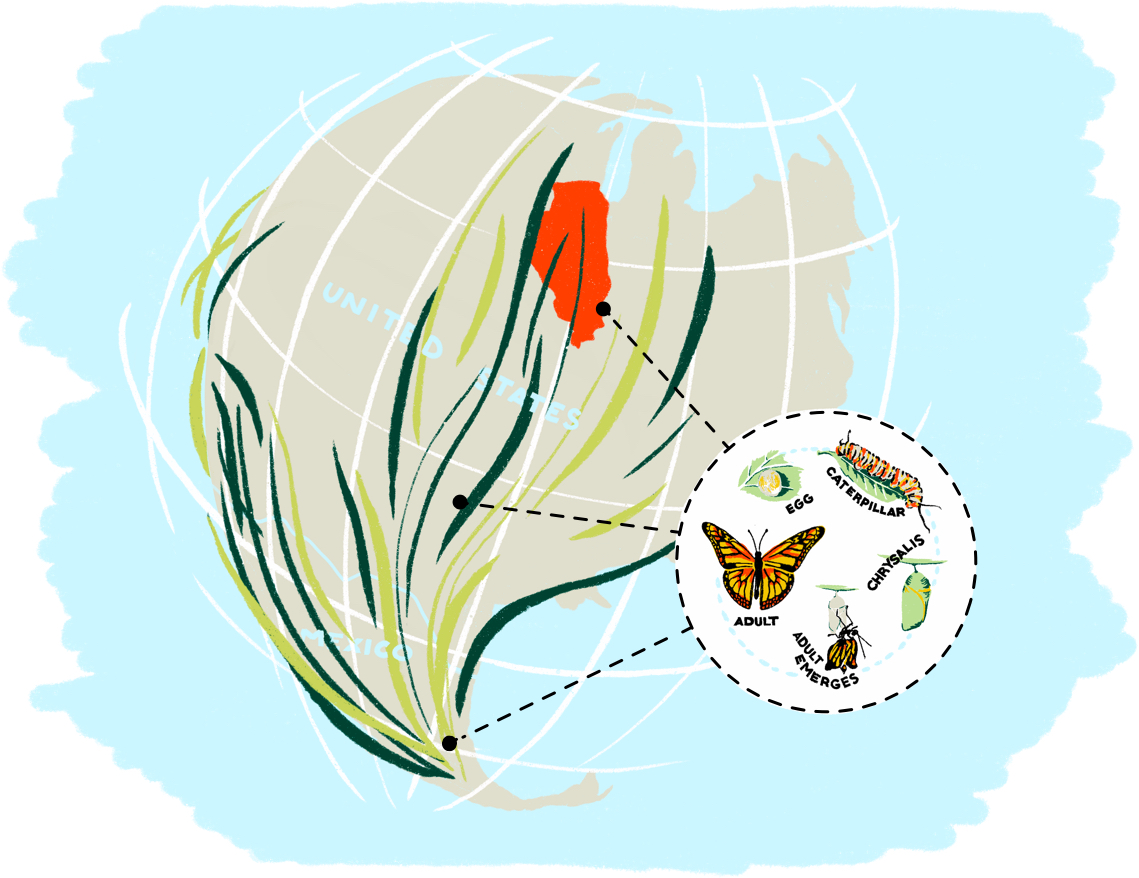
The Great Monarch Migration
It takes 2 or 3 generations of butterflies to migrate from the mountains of Michoacán, Mexico, to the prairies of Illinois in the spring months. By late summer, a ‘super generation’ emerges, equipped to travel an estimated 2,500 miles back to Mexico for overwintering.
Illinois offers these iconic butterflies the crucial milkweed resources they require for breeding, along with the nectar plants they rely on for subsistence during their migratory journey.
About the Illinois Monarch Project
Over the past 20 years, the eastern monarch population has faced a significant decline in migratory habitat. The Illinois Monarch Project collaborates with public and private partners, in addition to individuals across the state, to protect and enhance existing habitat and establish new habitat that supports monarch butterflies and other pollinators.
With your help, we can reach our goal of adding 150 million new milkweed stems and other nectar resources to the Illinois landscape by 2038.
Join fellow Illinoisans in fostering a culture of conservation that ensures future biodiversity and flourishing pollinator habitat across diverse urban and rural landscapes in Illinois.
Make A Difference
Select the tab below that best reflects your interest or specialty, and learn how to help monarch butterflies and their native habitat thrive into the future.
Want to make a difference today? Here are five things you can do to give monarch butterflies a boost.
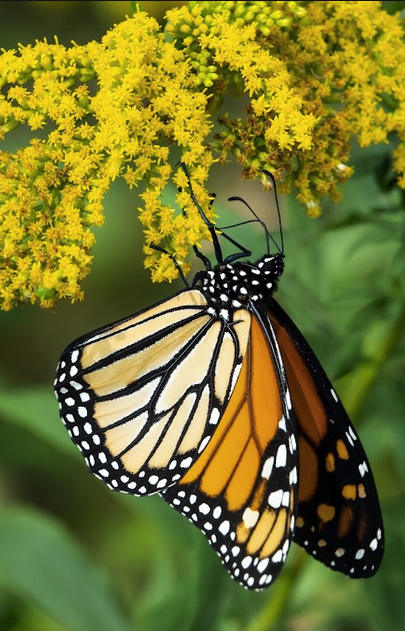
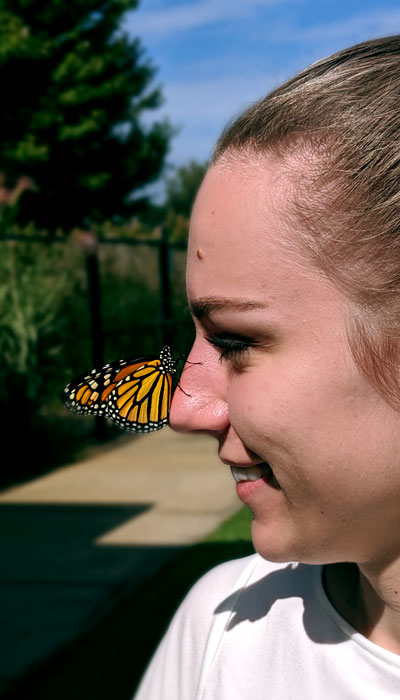
Photo credit: Iris Caldwell, University of Illinois at Chicago
Whether you have a few pots on a porch, or acres of sprawling land, every Illinois resident plays a part in the regeneration of this vital pollinator. Every milkweed stem counts. Every nectar-producing wildflower brings the monarch one step closer to survival. Learn how to make a difference from your own backyard.
As of June 2026, over 4,300 Monarch Waystations, or monarch habitats, were registered with Monarch Watch in Illinois – many of which exist in individual home gardens.
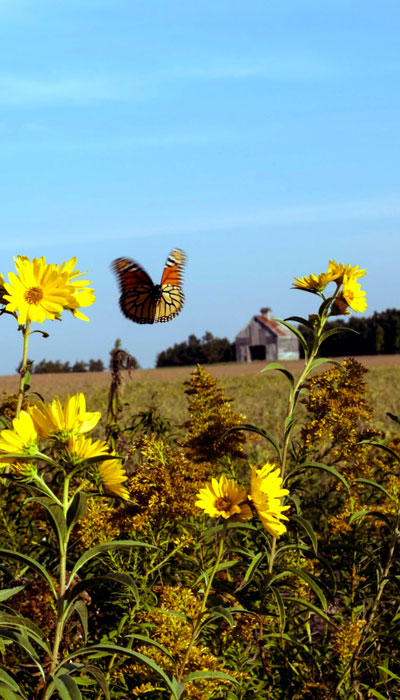
Photo credit: U.S. Fish and Wildlife Service
The reciprocal relationship between Illinois producers and monarchs is a thing of beauty. Farmers’ futures depend on thriving pollinator populations. While agriculture industry specialists support the future of monarchs through sound science and research, outreach and education practitioners work closely with the agricultural community to share and encourage best practices for conserving, enhancing, and creating monarch habitat.
Agriculture in the Classroom programming provides pollinator specific education to over 106,000 students and nearly 5,000 teachers across Illinois.
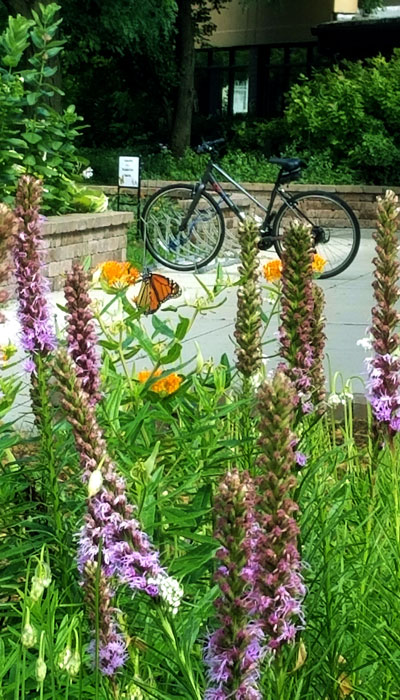
Photo Credit: Dolly Foster, Oak Lawn Park District
Urban, suburban, and rural communities are home to a range of gathering spaces, from corporate campuses and local businesses, to schools, cultural institutions, and parks. From Chicago to Carbondale, communities are hubs of activity that bring people together to fuel the feeding, breeding, and migration of monarchs.
As of 2026, 75 mayors in Illinois have signed onto the Mayor’s Monarch Pledge.
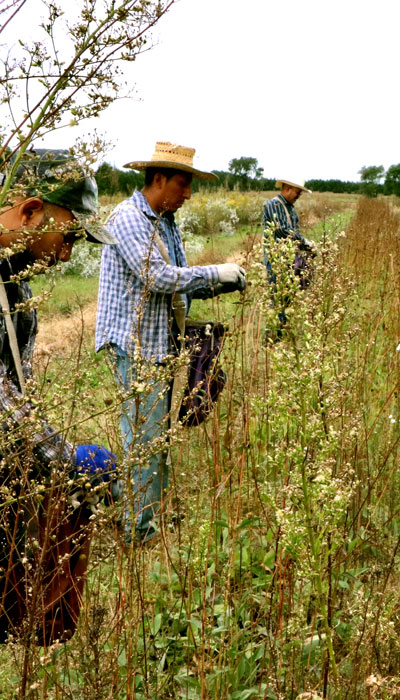
Photo Credit: Bridget Henning, Illinois Department of Natural Resources
From state lands to land trusts and county forest preserves, natural land managers have a long history of protecting and stewarding the unique natural heritage of Illinois. Through the preservation and restoration of native ecosystems, there’s room for these natural protectors to make a lasting impact on this incredible species.
Since 2014, over 96,000 acres of new habitat has been added to Illinois’ protected lands network, providing an estimated 3.8 million milkweed stems.
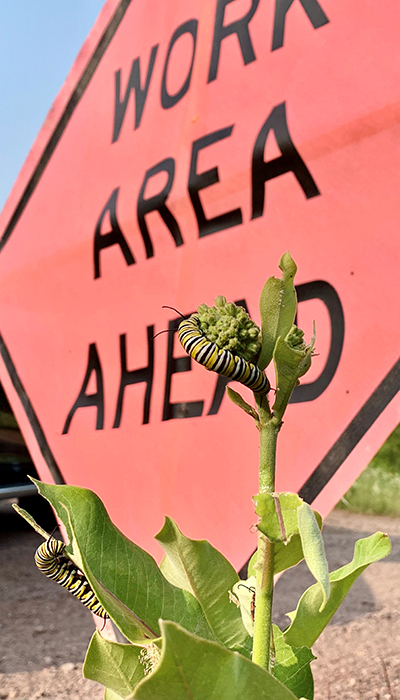
Photo credit: Darren Throop, American Transmission Company
Imagine traveling across our country’s highways with no rest stops along the way. Monarch butterflies, one of the great migratory species of our day, face a steep and rapid decline of rest stops along their 2,500 mile journey from Mexico to Illinois. State and local road authorities, electric and gas utilities, and other infrastructure land managers have the opportunity to foster feeding and breeding stations for monarchs along rights-of-way habitat across Illinois.
Mowing guidelines set forth by the Illinois DOT in 2017 resulted in the creation and enhancement of over 80,000 acres of monarch and pollinator habitat throughout the state
Additional Resources:
See how we’re making a difference along Route 66
Milkweed Mania
Since 2014, we’ve already seen an estimated 108 million additional milkweed stems planted across Illinois.
This puts us two-thirds of the way toward our Action Plan goal of 150 million stems planted by 2038.
Catch up on all we’ve achieved and what’s in store with our 10-year progress report.
Monarch Milestones
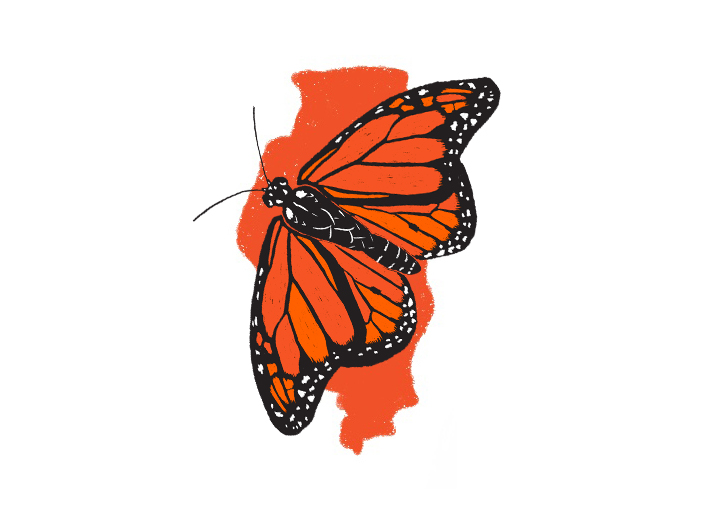
Illinois adopts the monarch as the state insect.

White House establishes the Federal Pollinator Health Task Force; the US Fish & Wildlife Service is petitioned to protect the monarch under the Endangered Species Act.

Illinois declares the monarch the Species of Greatest Conservation Need; the Midwest Association of Fish & Wildlife Agencies (MAFWA) begins a 20-year plan for monarch conservation in Illinois.

Illinois surpasses 1,000 registered Monarch Watch Waystations and the Illinois Monarch Project hosts the first statewide Monarch Summit.
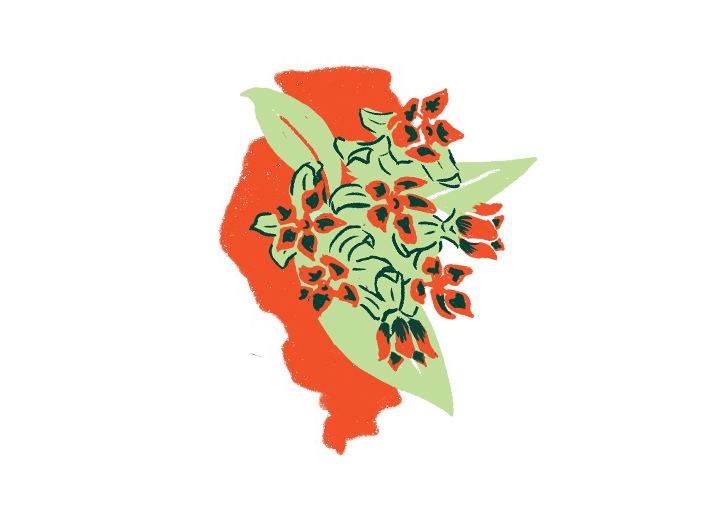
Illinois designates milkweed as the state wildflower; MAFWA sets a goal of adding 1.3 billion milkweed stems across critical monarch habitat by 2038.
Illinois Departments of Natural Resources, Agriculture, Transportation, and Environmental Protection sign an agreement committing their support of the Illinois Monarch Project.

Illinois surpasses 2,000 Monarch Watch Waystations, and designates the month of May as “Monarch Month” to be observed annually in honor of the state insect.
The Second Monarch Summit launches the statewide implementation of the Illinois Action Plan, with the US Fish & Wildlife Service expected to make a listing decision for the monarch butterfly under the Endangered Species Act.

UIC and the Illinois Department of Natural Resources release a 10-year progress report on the status of voluntary monarch conservation efforts; over 108 million new milkweed stems added across Illinois since 2014.

We did it! 150 million milkweed stems added to the Illinois landscape.
Celebrating 10 Years of Progress
The Illinois Monarch Project 10-year Progress Report presents the first comprehensive assessment of the state’s progress toward reaching the goals outlined in the Illinois Monarch Action Plan.
Through rights-of-way commitments, agricultural programs, improvements in grassland and protected natural areas, meaningful urban lands contributions and public engagement efforts, the report demonstrates how voluntary conservation relies on diverse participation to actively produce habitat benefits.
With a committed network of partners like yourself, Illinois is well‑positioned to create lasting, resilient conservation outcomes that ensure monarch butterflies and pollinator habitats continue to thrive far into the future.
No action is too small
Whether you’re a casual monarch enthusiast or an organization invested in environmental stewardship, there are ample resources available that make protecting monarch butterflies and their native habitat easy for everyone.
Wondering what more you can do? Explore our recommended action items for organizations and individuals. It’s never too late to make a difference.
Read the Action Plan
Ready to dig into the details? Look no further than the Illinois Monarch Action Plan, a living document outlining the goals, strategies, and conservation actions you can take to support the habitat and population of monarch butterflies and other pollinators across the state.
Thank you to all the organizations participating in this year’s Illinois Monarch Pledge!



Sector Leaders
The Illinois Monarch Action Plan was developed by a cross-sector coalition of agencies, organizations, and individuals committed to supporting the monarch butterfly.












THANK YOU TO OUR PARTICIPATING STAKEHOLDERS FOR SUPPORTING THE DEVELOPMENT OF THE ILLINOIS MONARCH ACTION PLAN
Ag in the Classroom – Ag Innovations – Ameren – Association of Illinois Electric Cooperatives – Association of Illinois Soil & Water Conservation Districts – BASF – Bloom Township – Boone County Conservation District – Champaign County Forest Preserve District – Chicago Academy of Sciences – Chicago Living Corridors – Chicago Park District – Chicago Zoological Society – City of Bloomington – City of Peoria – CN Railroad – ComEd – Ducks Unlimited, Inc. – Dupage Monarch Project – Eastern Illinois University, Urban Butterfly Initiative – Engie Distributed Solar – Environmental Defenders of McHenry County – Exelon Nuclear – Faith in Place – Federal Highway Administration – Field Museum – Flagg Township – Forest Preserve District of DuPage County – Forest Preserve District Will County – Friends of the Kankakee – Grand Prairie Friends – Great Rivers Country – GROWMARK – Illinois Audubon Society – Illinois Beef Association – Illinois Corn Growers Association – Illinois Department of Agriculture – Illinois Department of Military Affairs – Illinois Department of Natural Resources – Illinois Department of Transportation – Illinois Environmental Council – Illinois EPA BOW Watershed Management Section – Illinois Farm Bureau – Illinois Fertilizer and Chemical Association – Illinois Green Economy Network (IGEN) – Illinois Livestock Developer Group – Illinois Native Plant Society – Illinois Natural History Survey – Illinois Nature Preserves Commission – Illinois Pork Producers – Illinois Route 66 Scenic Byway – Illinois Sierra Club – Illinois Soybean Assocation – Illinois Specialty Growers – Illinois Tollway – Institute for Conservation Leadership – Lincoln Heritage RC&D – Lincoln Park Zoo – Logan County Highway Department – Mason State Nursery – McHenry County Conservation District – Metropolitan Mayors Caucus – Midwest Association of Golf Course Superintendents – Monarch Joint Venture – Nicor – Oak Lawn Park District – Openlands – ParkLands Foundation – Peoria GC Monarch Task Force – Peoria Park District – Pheasants Forever / Quail Forever – Prairie Rivers Network – Prairie State Conservation Coalition – Private Individuals – Rock Island County Forest Preserve District – Sand County Foundation – Shawnee National Forest – Sierra Club – Sugar Grove Nature Center – The Conservation Foundation – The Garden Clubs of Illinois, Inc. – The Land Conservancy of McHenry County – The Nature Conservancy – The Wetlands Initiative – Trees Forever – Triton College – U.S. Army Corps of Engineers – U.S. Department of Agriculture Farm Service Agency – U.S. Department of Agriculture Natural Resources Conservation Service – U.S. Fish & Wildlife Service – U.S. Forest Service University of Illinois Extension – University of Illinois Urbana-Champaign – University of Illinois‐Chicago – Vermilion County Conservation District – Waterborne Environmental – Wetlands Initiative – Wildlife Habitat Council